+ 39 339 7379254 | divertisportasd@gmail.com

The invisible resources of growth in sport

Sleep, attention and relationship with digital: how to accompany girls and boys in the small choices of every day
Dr. Lucia Battaglia
Sports Psychologist
“He trains hard, but lately I always see him tired” Or: “He has always been focused, but for a few weeks he seems to get distracted easily“.
These are observations that many parents share during the sports season. The first reaction is often to look for an answer in training: the workload has increased? Something needs to change? He lost motivation?
Sometimes, but, the answer is not found on the field.
The growth of a girl or boy also passes through what happens away from training. Sleep, the relationship with digital, the ability to maintain attention and self-regulate are less visible resources, but fundamental for well-being, learning and development.
The research of recent years invites us to shift our gaze. Before we even ask ourselves how to train better, it can be useful to ask ourselves which conditions really help a person grow. There are no recipes that are valid for all families, but knowing these aspects allows you to observe the daily lives of daughters and sons with greater awareness.
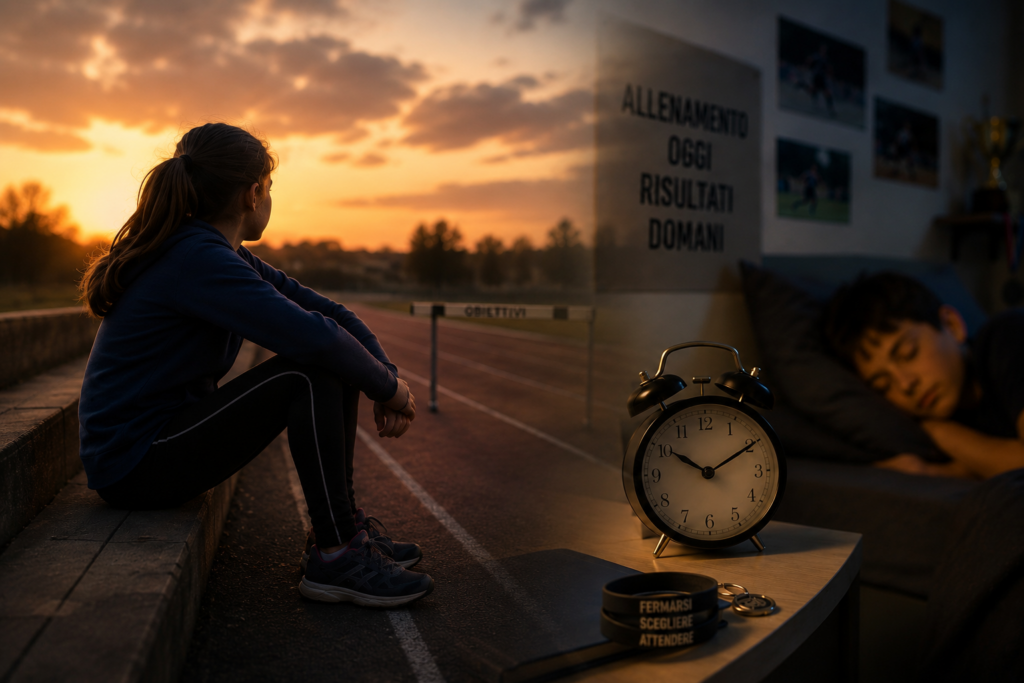
Sleep: when growth continues even after training
When a workout ends, we tend to think that the day's work is done. Actually, an important part of learning begins in the following hours.
During sleep the brain continues to process experiences, consolidates what has been learned and reorganizes much of the information collected during the day. For those who practice sport this means that rest is not just a moment of physical recovery, but an essential component of the growth process.
Scientific evidence shows that good sleep quality is associated with better attention skills, to more effective motor learning and more adequate psychophysical recovery (Fullagar et al., 2015). Matthew Walker (2017) describes sleep as one of the main processes involved in memory, in learning and emotion regulation.
Italian research has also made an important contribution. Studies coordinated by Luigi De Gennaro and his group at Sapienza University of Rome have highlighted the role of sleep in memory processes, attention and cognitive functioning during developmental age.
Another fact deserves attention. In a study conducted on adolescent athletes, Milewski and collaborators (2014) observed that routinely sleeping fewer than eight hours per night was associated with a greater likelihood of injury. Injuries depend on many factors and this result does not demonstrate a cause-effect relationship, but remember how much rest represents one of the conditions that promote health and well-being.
For parents, Therefore, the question is not only “How many hours does he sleep?”, but also “My daughter or son's sleep is truly restful?”. Fall asleep easily, Waking up rested and being able to face the day with energy can be as useful signals as the number of hours spent in bed.
Digital: the problem is not the smartphone, but the relationship we build with it
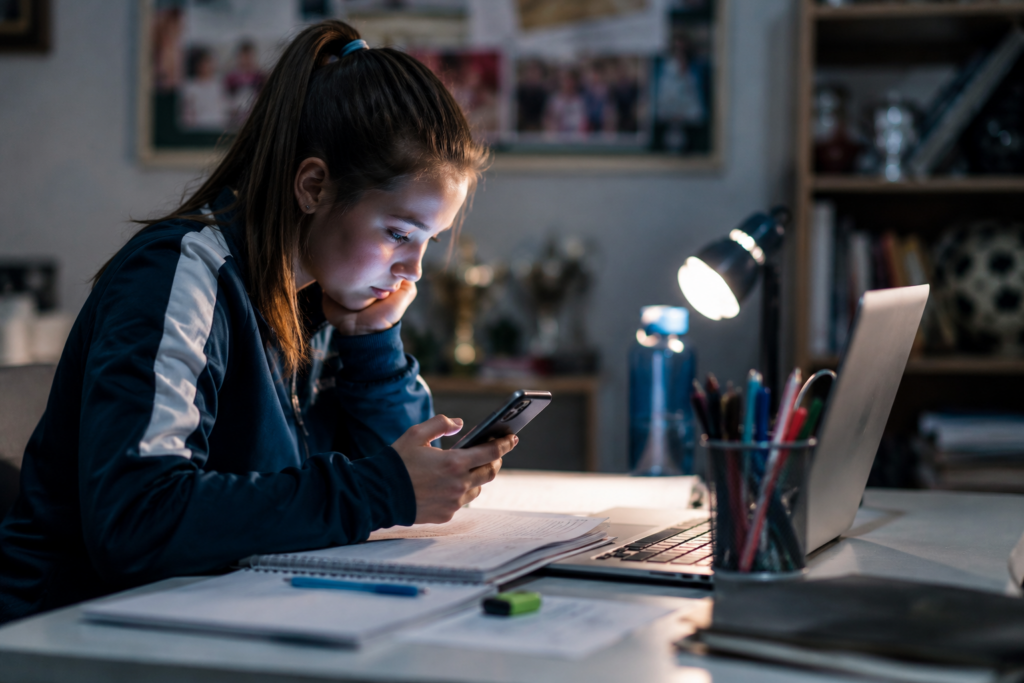
Talking about sleep today inevitably also means talking about technology. Smartphone, video games, Social media and digital platforms are part of girls' daily lives, children and adults. For this reason the question should not be whether to eliminate them, but how to learn to use them in a balanced way.
Cain and Gradisar's reviews (2010) and the meta-analysis by Carter and collaborators (2016) show that the use of electronic devices in the evening is frequently associated with falling asleep later, to a reduction in sleep duration and a lower quality of rest.
It doesn't just depend on the light emitted by the screens. Notifications, video, Always new games and content keep the brain in a state of activation that makes it more difficult to slow down and prepare for sleep.
The theme, but, It's not just about rest. Every time a girl or boy chooses whether to respond to a notification, stop a video or continue scrolling social media, skills such as attention control come into play, the ability to inhibit an impulsive response and delay immediate gratification. These are skills that are part of the so-called executive functions and which are also important in studying, in relationships and sports.
More than introducing rigid bans, it can be useful to build some shared habits together, favoring moments of the day in which screens leave room for rest, conversation or other activities. The goal is not to demonize technology, but help girls and boys to use it without it becoming the only way to fill every free moment.
Self-regulation is built in small choices
The thread that unites sleep, attention and relationship with digital is self-regulation.
According to Barry Zimmerman (2000), Self-regulation means learning to observe your own behavior, recognize one's needs and direct one's actions towards significant objectives. It is not an innate ability, but a competence that develops gradually through experiences and relationships.
Sport represents one of the richest contexts for training it. Every training teaches that improvements take time, that mistakes are part of learning and that commitment does not always produce immediate results.
Even in daily life there are many opportunities to exercise this ability: choose to go to sleep when your body needs it, stop using your smartphone, keep your attention on a task or agree to wait before getting what you want.
Research on delay of gratification, started with Walter Mischel and subsequently deepened by Watts, Duncan e Quan (2018), they also remember that this competence does not depend only on individual characteristics, but it grows within relationships and educational contexts.
For this reason, the role of adults is not to replace the choices of girls and boys, but to accompany them in building habits that, with time, can become increasingly autonomous.
Growth that affects the whole person
In sport it is easy to observe what is visible: an improved technical gesture, a race well faced, a result achieved. It is more difficult to realize what makes that progress possible.
Sleep adequately, learn to manage attention, building a balanced relationship with digital and developing self-regulation skills are skills that are trained every day and which will accompany girls and boys well beyond the sporting experience. As parents, caregiver, coaches, coaches and educational figures cannot control every aspect of their daily lives. However, we can create contexts that promote well-being, observe their needs with curiosity and accompany them in building healthy and sustainable habits.
Because growth is not measured only in sporting results. It is built, day after day, in experiences, in relationships and in the small daily choices that help little girls, children, girls and boys to become increasingly autonomous people, aware and capable of taking care of themselves.
Bibliography
Walker, M. (2017). Why We Sleep: Unlocking the Power of Sleep and Dreams. Scribner. Full lager, H. H. K., Skorski, S., Duffield, R., hams, D., Coutts, A. J., & Meyer, T. (2015).
Sleep and athletic performance: The effects of sleep loss on exercise performance, and physiological and cognitive responses to exercise. Sports Medicine, 45(2), 161–186.
Milewski, M. D., Bearded, D. L., Bishop, G. A., Pace, J. L., Ibrahim, D. A., Wren, T. A. L., &
Beard, A. (2014). Chronic lack of sleep is associated with increased sports injuries in adolescent athletes. Journal of Pediatric Orthopaedics, 34(2), 129–133.
Curcio, G., Ferrara, M., & From Gennaro, L. (2006). Sleep loss, learning capacity and
academic performance. Sleep Medicine Reviews, 10(5), 323–337.
Cain, N., & Gradisar, M. (2010). Electronic media use and sleep in school-aged children and adolescents: A review. Sleep Medicine, 11, 735–742.
Carter, B., Rees, P., Hale, L., Bhattacharjee, D., & Parade car, M. S. (2016). Association
between portable screen-based media device access or use and sleep outcomes: A systematic review and meta-analysis. JAMA Pediatrics, 170(12), 1202–1208.
Zimmerman, B. J. (2000). Attaining self-regulation: A social cognitive perspective. In M. Boekaerts, P. R. Pintrich, & M. Zeidner (Eds.), Handbook of Self-Regulation. Academic Press. Watts, T. W., Duncan, G. J., & Mandarin, H. (2018). Revisiting the Marshmallow Test: A conceptual replication investigating links between early delay of gratification and later outcomes. Psychological Science, 29(7), 1159–1177.